
Every few years, a new wireless standard emerges, promising faster speeds and better reliability. But the leap from Wi-Fi 6 to Wi-Fi 7 (802.11be) is different. It is not just about incremental speed increases; it is a fundamental redesign of how data moves through the air.
At EFOCE, we believe in transparent engineering. To understand why our upcoming Wi-Fi 7 access points deliver unprecedented performance, you need to look at the two pillars of this new standard: ultra-wide channel bandwidth and extreme modulation.

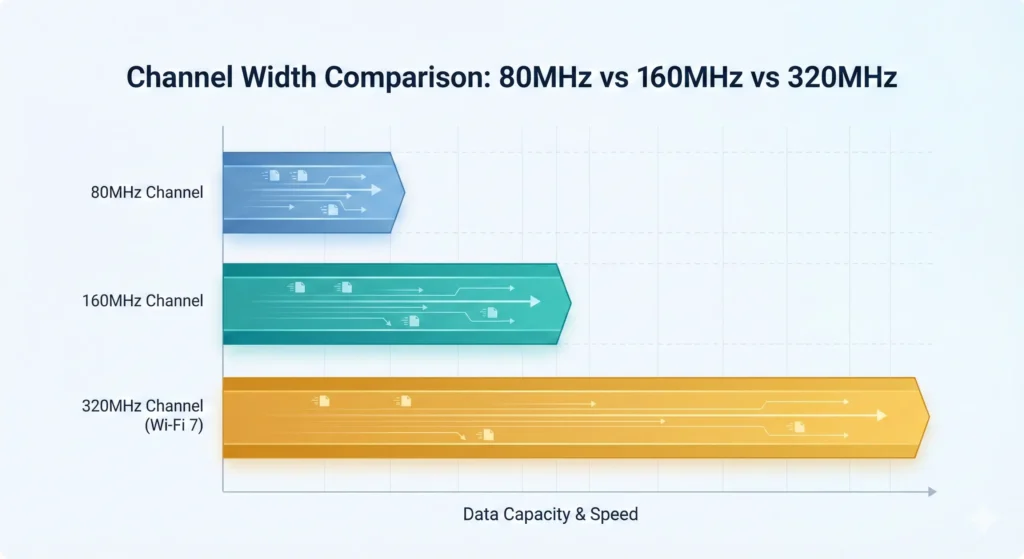
The 320MHz Channel: Doubling the Highway
Think of wireless spectrum as a highway. Wi-Fi 6 introduced 160MHz channels, effectively widening the road to allow more traffic. Wi-Fi 7 takes this to an extreme by opening up 320MHz channels exclusively within the pristine 6GHz band.
By doubling the maximum channel width, Wi-Fi 7 instantly doubles the theoretical capacity for data transmission. This means a single, uncompressed 8K video stream or a massive multi-gigabit software update can occupy its own massive lane without causing traffic jams for other devices on the network. For enterprise environments with hundreds of concurrent users, this wide-lane approach drastically reduces latency.
4K-QAM: Packing More Data into Every Signal
If channel width is the size of the highway, Quadrature Amplitude Modulation (QAM) is how tightly you can pack the cargo inside each vehicle.
Previous generations topped out at 1024-QAM. Wi-Fi 7 introduces 4096-QAM (4K-QAM). This incredibly dense modulation scheme allows each signal pulse to carry 12 bits rather than 10 bits. In real-world terms, this represents a 20% increase in pure data transmission efficiency.

When you combine the massive 320MHz highway with the hyper-dense 4K-QAM cargo packing, the result is a network capable of delivering over 30 Gbps theoretically. It is the invisible infrastructure required for the metaverse, real-time AI processing, and the all-wireless enterprise.